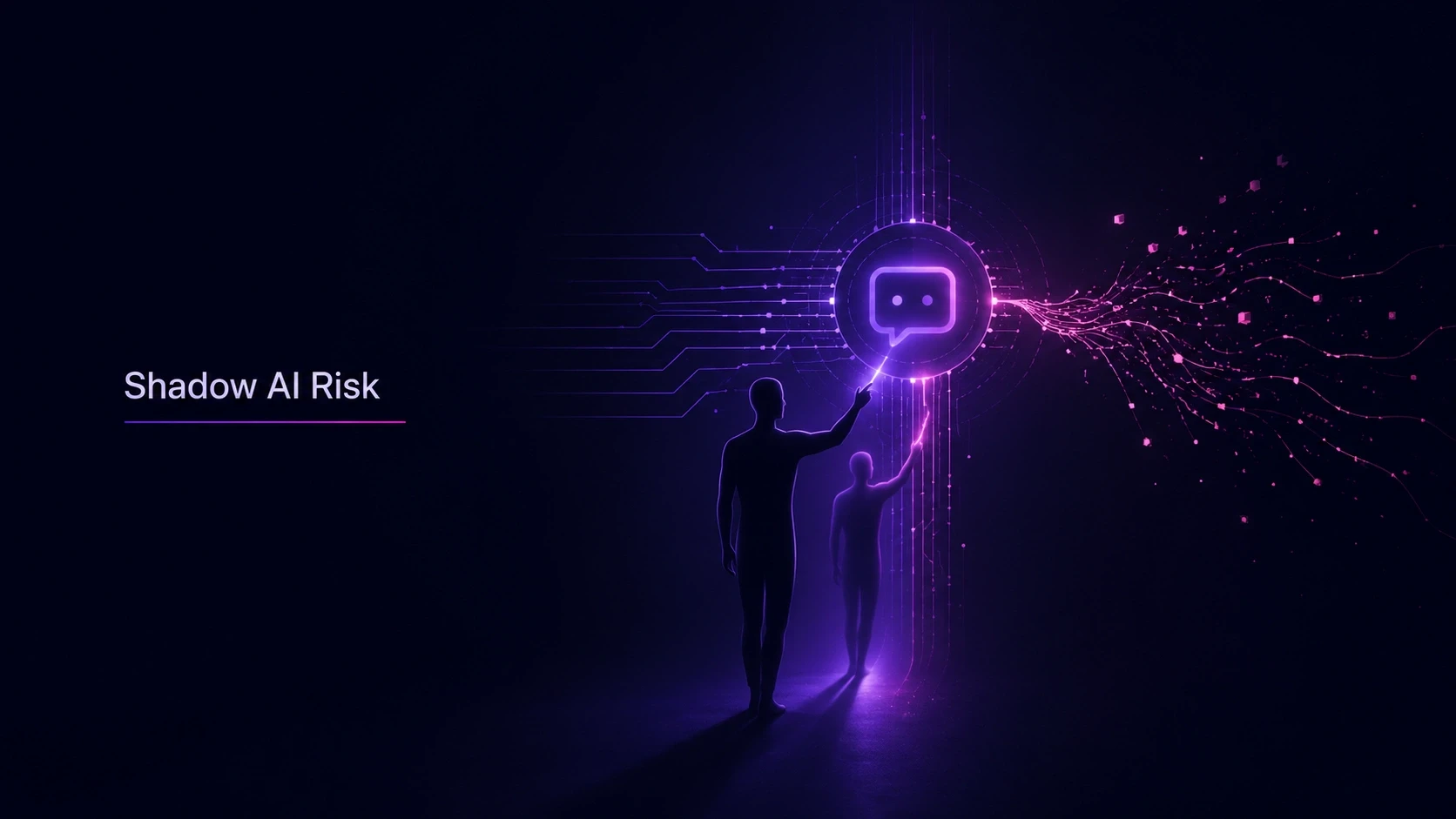
Shadow AI: The Hidden Data Risk Inside Every Enterprise

Saniya Khatri
Shadow AI is the unsanctioned use of AI tools by employees without IT approval or oversight, and it is quietly becoming one of the largest unmonitored data exit points in the modern enterprise.
What Is Shadow AI, and Why Is It Spreading So Fast?
How Shadow AI Leads to Real Data Exposure
The Real Cost: What Shadow AI Breaches Actually Add Up To
Why Blocking AI Tools Outright Does Not Work
How Vectoredge Helps You Regain Visibility Over Shadow AI
Frequently Asked Questions About Shadow AI
What Is Shadow AI, and Why Is It Spreading So Fast?
Shadow AI is the use of AI tools, chatbots, browser extensions, or AI features embedded in everyday apps, without the knowledge, approval, or governance of an organization's IT and security teams. It is a direct descendant of shadow IT, but far harder to contain, because generative AI tools require no installation, no procurement approval, and no technical skill to use.
According to a 2025 Gartner survey of cybersecurity leaders, 69% of organizations suspect or have evidence that employees are using prohibited public generative AI tools at work. Separate 2026 workforce research found that roughly half of employees admit to adopting AI tools without employer approval, and a large share believe the productivity benefit is worth the policy risk.
The appeal is simple. An employee facing a tight deadline opens a free AI chatbot, pastes in a document, spreadsheet, or block of code, and asks for a summary or rewrite. It feels like a private, disposable interaction. In reality, that data has just left the organization's control and entered a third-party system with its own retention, training, and access policies.
Shadow AI also spreads faster than earlier waves of shadow IT because it hides inside tools employees already trust. A writing assistant plugin, a meeting note summarizer, or an AI feature quietly added to a spreadsheet app can all route content to an external model without a distinct sign-up step that security teams would notice. The entry point is not a new app icon; it is a checkbox already switched on inside software the company approved years ago.
How Shadow AI Leads to Real Data Exposure
Shadow AI is not a theoretical risk. It is an active data exfiltration channel that most security teams cannot see. Employees routinely paste enterprise data into consumer-grade AI tools that were never vetted for confidentiality or compliance.
Survey data shows the scope of what gets shared: 33% of employees admit to sharing enterprise research or datasets with AI tools, 27% have revealed employee data such as salary or performance records, and 23% have input company financial information. One widely cited example is Samsung, which banned internal GenAI use in 2023 after staff shared proprietary source code and internal meeting notes with a public chatbot.
Shadow AI vs. shadow IT is a useful distinction: shadow IT typically involves an unapproved SaaS tool storing data, while shadow AI often means that data is used to train or fine-tune a third-party model, making it effectively impossible to retrieve or delete afterward. Once sensitive data crosses into a public model's processing pipeline, the organization loses both visibility and control over where it goes next.
The Real Cost: What Shadow AI Breaches Actually Add Up To
Shadow AI is expensive, and the cost is now measurable. According to IBM's 2025 Cost of a Data Breach Report, incidents involving shadow AI carried an average cost of $4.63 million, compared to $3.96 million for breaches without shadow AI involvement, a premium of roughly 16%. IBM's research also found that shadow AI incidents now account for approximately 20% of all breaches studied.
Gartner projects that shadow AI security incidents will affect 40% of organizations globally by 2030 if current adoption and governance trends continue. The gap driving this is visibility: most 2026 industry surveys place full enterprise visibility into employee AI usage at under a third of organizations, meaning the majority of security teams are defending against a risk they cannot currently measure.
Financial exposure aside, shadow AI creates compliance liability. Data protection regulations like GDPR and HIPAA assume an organization can account for where regulated data travels. When an employee pastes customer PII into an ungoverned AI tool, that accountability breaks, and the organization may be unable to demonstrate compliance even if no visible breach occurs.
Why Blocking AI Tools Outright Does Not Work
The instinctive response to shadow AI is to block every unapproved AI domain at the network level. In practice, this approach fails for the same reason shadow IT policies failed before it: employees find the productivity gain valuable enough to route around the block, whether through personal devices, mobile data, or browser extensions that are harder to detect.
Blanket blocking also pushes AI usage further into the shadows, away from any visibility at all, rather than reducing it. A more durable strategy treats shadow AI the way mature security programs treat shadow IT: assume it is happening, build the visibility to detect it, and create sanctioned alternatives good enough that employees choose them voluntarily.
This is where a data-centric approach outperforms a tool-centric one. Instead of trying to enumerate and block every AI endpoint, which changes weekly, security teams get more durable protection by monitoring what sensitive data is doing, regardless of which application it moves through.
New AI tools and browser extensions launch faster than any blocklist can track, so a list-based defense is out of date the moment it ships. A policy built around data classification and monitored data flow stays effective even as the underlying tools change week to week, because it protects the asset that actually matters instead of chasing every new destination it might travel to.
How Vectoredge Helps You Regain Visibility Over Shadow AI
Vectoredge approaches shadow AI as a data security problem rather than an application-blocking problem. By focusing on where sensitive data lives, moves, and gets exposed, Vectoredge gives security teams the visibility that blanket domain blocking cannot provide.
This means detecting when regulated or sensitive data is about to leave through an unmanaged channel, including AI tools, before it happens, rather than discovering the exposure during incident response months later. Combined with clear data classification and policy enforcement, this approach lets organizations support employee AI adoption instead of fighting it, while keeping sensitive data inside governed boundaries.
The goal is not zero AI usage. It is zero ungoverned exposure. Organizations that get this balance right capture the productivity benefits of AI adoption without inheriting an unmanaged, unmeasured data risk.
Frequently Asked Questions About Shadow AI
What is shadow AI?
Shadow AI is the use of AI tools, models, or AI-powered features by employees without the knowledge or approval of their organization's IT and security teams.
Is shadow AI the same as shadow IT?
No. Shadow IT refers to any unapproved software or service, while shadow AI specifically involves AI tools, and carries the added risk that submitted data may be used to train or fine-tune a third-party model.
How common is shadow AI in the workplace?
Very common. A 2025 Gartner survey found 69% of organizations suspect or have evidence of employees using prohibited public generative AI tools, and separate 2026 research puts individual employee adoption at roughly half the workforce or higher.
Does shadow AI actually increase breach costs?
Yes. IBM's 2025 Cost of a Data Breach Report found breaches involving shadow AI cost an average of $4.63 million, about 16% more than breaches without shadow AI involvement.
How can organizations reduce shadow AI risk without banning AI tools?
By shifting from blocking specific AI applications to monitoring and protecting sensitive data itself, so that exposure is caught regardless of which tool or channel it moves through.
What’s Next?
Here are two steps you can take today to enhance your organization's data security and minimize risk:
1. Book a Personalized Demo Schedule a demo to see our solutions in action. We’ll customize the session to address your specific data security challenges and answer any questions you may have.
2. Follow Us for Expert Insights Stay ahead in the world of data security by following us on LinkedIn, YouTube, and X (Twitter). Gain quick tips and updates on DSPM, threat detection, AI security, and much more.
Saniya Khatri
Saniya Khatri is a cybersecurity research and analytics professional at Vectoredge, with four years of expertise in analyzing emerging threats and crafting actionable insights. Specializing in AI-driven attacks, data protection, and insider risk, Saniya empowers organizations to navigate the evolving threat landscape with confidence.
Stop Guessing. Start Knowing. See Real Security Intelligence.
Transform chaotic security alerts into crystal-clear threat intelligence with AI that actually explains what's happening in your environment.